
Pet loss and the holidays
Thanksgiving Without Your Pet
If this is your first Thanksgiving without your pet, the one you’re most thankful for may be the one you’re missing. Here’s help with the family gatherings, the familiar traditions and the quiet hours afterward.
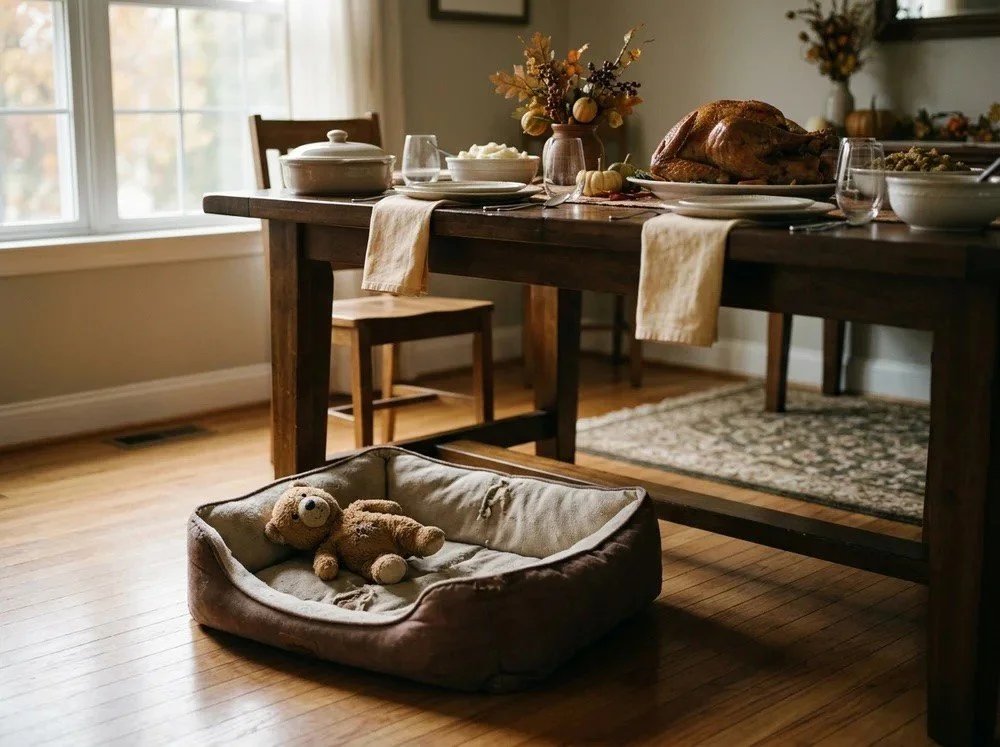
You open the oven to check the turkey and take a step to the left. That was where your dog lay every Thanksgiving, on the strip of floor between the stove and the pantry door. From there they could watch everything you did, and if anything fell, they could get to it before you did. One year you put their bed in the living room so they’d be out of the way. By the time you were peeling potatoes, they were back on the kitchen floor, lying exactly where you needed to stand.
This year you have all the room you need. You stepped around them anyway.
From the other room your brother calls, “When do the rolls go in?”
You look at the timer. “Twenty minutes.”
“Need a hand with anything?”
“No, I’ve got it.”
You’re glad he asked something you know how to answer. You hear him go back to the game. The oven door is still open, the heat is on your face, and for a moment you can’t remember what you came over here to do.
Then the gravy needs whisking and somebody wants to know where the good serving spoon went. Dinner still has to get to the table. Nobody else in the house knows that half a step has just undone you, and there’s no obvious moment to tell them. You close the oven. You find the spoon. You keep going, partly because the potatoes won’t mash themselves and partly because being busy is easier than standing still in that kitchen with nothing to do with your hands.
Key takeaways
- You can be thankful for the years you had with your pet and still be devastated that there weren’t more. Being grateful doesn’t oblige you to feel happy on Thursday.
- Hand over the part of the day you dread most, and tell one person beforehand whether you’d like your pet’s name said, or your turn skipped when everyone gives thanks.
- Plan the first few minutes through your own front door, and ask for company on Friday, when many people will assume the hard day is over.
Before Thanksgiving: preparing for the day
A holiday can be hard weeks before it arrives. Somebody starts the group chat about who’s bringing what, and you can already picture the kitchen. You remember the dog getting up every time the fridge opened, or the cat taking the one chair you’d pulled out for yourself. Last year you’d probably have called them a nuisance. You’d have said it fondly, with your hand on their head.
Other people may not see it the way you do. If they saw your dog for one afternoon a year, they remember who stole a roll. You remember the other 364 days as well: the sound of them asking to go out, the patch of sunlight they followed around the living room, how they let you know they’d had enough of being petted. In a review of 17 qualitative studies of pet loss, Michelle Cleary and colleagues found that the relationship itself and the support people had afterward came up again and again in what bereaved owners said. The review wasn’t about holidays. It does help explain why the group chat is a conversation about where to eat, while you’re working out how to spend a whole day doing things you always did with someone who isn’t there.
What you need from Thursday depends on where you are.
If they died days ago, you may still be making calls, and their leash may still be on the hook by the door. You told two relatives and assumed the news would get around. The thought of explaining it across a table full of people is more than you can manage. You can hand that job to one person now. “Would you tell everyone before Thursday? I’m coming and I want to see them. I just can’t tell the story again.” Then give them the words you want passed on, and only those. “Max died on Saturday. It was very sudden.” That can be the whole message. If you’d rather people didn’t ask what happened, say that too, and let your relative be the one to say it.
If you agreed to host back in October, and the person you live with wants the day to go ahead, you may both be right. They’ve bought the turkey. They miss the dog too, and a full house may be how they want to get through it. You can agree about missing the dog and still disagree about Thursday. It helps to stop talking about whether to have Thanksgiving and go through the day in pieces.
“I don’t want to cancel,” your partner says. “Everyone’s already coming.”
“I don’t want to cancel either. I just can’t do the morning in that kitchen on my own.”
“Then I’ll do the turkey. You do the table and the pies.”
“And if I need ten minutes, I’m going to walk around the block. Can you keep things going?”
Jeannine Moga, a veterinary social worker, advises in holiday guidance published by NC State’s veterinary college that grieving people be realistic about how much they can manage, choose their commitments carefully and plan a way out before company gets to be too much. When you’re the host, the way out can’t be your car. It can be the back steps, or the dog’s old route around the block. Tell one person you’re stepping out, and ask them to give you a few minutes to yourself.
If you’re spending Thanksgiving on your own, it’s worth asking which kind of alone you mean. For some people, their pet was the one they spent the holiday with. There was no family dinner to go to, by circumstance or by choice, and Thanksgiving was the two of you, a long walk and the good leftovers. That house can feel emptiest on the day everyone else’s fills up. The University of Florida’s veterinary hospital, in its guidance for people facing special days after a pet’s death, says it’s fine to want nothing special that day or to want time on your own. If that’s what you want, make it a day you chose. Cook what you’d actually like to eat, not a turkey for one. If the time of your old afternoon walk is what you’re dreading, take the walk at that hour or go somewhere else entirely.
If what you want is somebody, just not a whole dinner, you can ask a friend or a neighbor for a smaller piece of the day. “I don’t think I can do the whole dinner, but could I come by for pie around four?” Or ask someone to bring coffee in the morning, before their own plans begin. You can see them in whatever you’re wearing. By the time everyone else sits down to eat, you’ll already have seen someone.
And if it’s been a year or more, you may be surprised that Thanksgiving still hurts. Other people may not expect it to. You may not have expected it either. It can help to tell one person why this day in particular. “Thanksgiving was a big day in our house. I keep thinking about how she used to wait by the oven.”
When everyone is giving thanks and you’re grieving
Thanksgiving is the one holiday built around a single question. What are you thankful for? You hear it in the grocery store and on the radio, and someone will probably ask it out loud before the turkey is carved.
You do have an answer. The trouble is that the first one to come to mind is the one you’ve lost. It might be the dog who met you at the door every evening for twelve years. It might be a cat who spent her first months with you behind the dryer, deciding whether you could be trusted, and the next fourteen years asleep in the bend of your knees. She never once came when she was called. She came at night, after the lights were off, and settled where she wanted to be, which was against you. If anyone asks what you’re grateful for, she’s the answer, and she’s why the question is hard to hear.
You can be thankful for every one of those years and still be devastated that there weren’t more. Being grateful for their life isn’t the same as accepting their death, and nobody needs you to do the second in order to mean the first.
People who tell you to focus on the good times usually mean it kindly. But the good times are what you miss.
Gratitude doesn’t oblige you to feel happy, either. The holiday tends to assume that naming what you have will lift your mood. This year it may not, and that isn’t a failing on your part. You don’t owe anyone a brighter face because of the date on the calendar.
Some of the celebrating may be more than you want to take part in. The toasts, the football, the cheerful noise in the kitchen can feel like a party in a house where someone has just died, because in your house someone has. You can come for the meal and leave before the rest. You can stay home. Neither choice says anything about how much you loved them.
What you’d ask for this Thanksgiving may be the one thing nobody at the table can give you. It can help to admit that, at least to yourself, instead of trying to feel something you don’t. And if you want to say something about them on Thursday, it doesn’t need a bright side. “I’m thankful for her. I just wish she were here,” is a thankful answer.
If this is the first of many difficult dates you’re facing, I wrote The First Year Without You to offer support throughout the twelve months after losing your pet, including the holidays, anniversaries and changes to your daily life that can be particularly hard to navigate.
At the Thanksgiving table
Whether you’re at a family dinner or a friend’s table this year, there may be a moment when someone suggests going around and saying what everyone’s thankful for. You can feel your turn coming from three chairs away. Each answer brings it closer, and you’re trying to decide whether you’ll say their name, and whether you’ll be able to get it out if you try.
You don’t have to decide at the table. Before you sit down, you can tell the host, “Could you skip me this year? I don’t trust my voice.” If you do want to say something, keep it short enough to say in one breath. “I’m thankful I had her for eleven years.” If your voice goes partway through, “Sorry. I miss her today,” is a complete answer, and you can nod to the person beside you to take their turn.
The University of Florida guidance encourages bereaved owners to tell the people close to them what would help, including whether they’d like their pet mentioned. Plenty of people leave the name out on purpose because they’re afraid of upsetting you. If you want to hear it, they may need to be told. “You can talk about her today. I’d like that.”
Not every question will be the one you hoped for. Someone may ask, “Are you going to get another one?” because they think looking ahead will cheer you up. You can let it go by and ask someone to pass the potatoes. You can also answer it. “Not now. I’d rather talk about her than about the next one.” If they press, and tell you the shelters are full of animals who need a home, you can be firm without being unkind. “Maybe one day. Today I’m still missing this one.”
Being told how well you’re coping can be harder to answer. You’ve cooked, or brought the pie, or asked everyone the right questions. Somebody squeezes your arm and says, “You’re doing so well.” From their seat, that’s what it looks like. From yours, you’ve watched three people open the back door without checking whether anyone was trying to get out, and each time you’ve thought of the dog. You don’t owe them the whole story, but you can give them more than a smile. “Thanks. Honestly, it’s been a hard day. I keep looking for him in the kitchen.” If there’s one person who knows how the day has really gone, ask them to take a short walk with you after dinner.
And sometimes someone says the name before you do.
“Remember the year she got the whole stick of butter off the counter?” your uncle says. “She sat there with it in her mouth like she’d done nothing.”
Your sister groans. “She wouldn’t let go of it. You had to swap her for her squeaky duck.”
“The duck and the good ball,” you say. You’d forgotten that part until now. “She held out for both.”
Then everyone has one. The time she barked at the mixer, then came back the minute it stopped to see what had dropped. The time she slept through the doorbell and woke up furious about it. Your nephew, who was little then, remembers her sleeping on his feet under the table. For a few minutes the table is full of her, not how she died, but how she lived. You can join in or just listen. And if one of those stories is one you want to keep, ask whoever told it to send it to you in a message later, so you have it in their words.
There may also be a stretch of the meal when things feel almost ordinary. Someone tells a story everyone has heard before and gets one detail wrong. Three people correct them at once, and you laugh before you can help it. You ask for another piece of pie.
Then, on the way home, you think about how easily you laughed. Crying at dinner would have made sense to everyone. Laughing is harder to explain, even to yourself. The University of Florida guidance speaks to this: feeling happier on a special day than you expected doesn’t make you disloyal to the pet you’re grieving. You can enjoy part of the meal and still sit in the driveway afterward because opening the front door feels like too much.
Coming home without your pet
The engine is off. The porch light is on because you left it on. You sit for a moment with the leftovers on the passenger seat, wrapped in foil, and you know exactly what used to happen next.
Before you got your key out of the lock, they were there. The dog’s tail hit the wall in the hallway. The cat told you, at length, how late you were. You put down whatever you were carrying because your hands were needed somewhere else, and you said hello before you did anything else. Your coat stayed on. The leftovers waited on the floor by the door. Everything after that, taking off your shoes, putting the food away, checking your phone, came after you’d said hello.
What you miss at the door may not be anything big. It may be those first ten seconds.
If you’re coming back to an empty house, it helps to plan those seconds before you leave. Leave a lamp on, or the radio playing low, so the house isn’t silent when you open the door. Decide what you’ll do first, and make it something with your hands: put the leftovers in the fridge, hang up your coat, make a cup of tea. If you know who you’d like to talk to, ask them before dinner whether you can call when you get in. If there’s nobody you want to call, or the person you’d usually call is hosting a houseful or three time zones away, you can still let someone know you’re home. Send a message that doesn’t ask for anything back. “Home. Thanks for today.”
If walking in alone is the part of the day you dread most, you don’t have to do it on Thursday night. You could ask to stay over wherever you’re having dinner and come home in daylight on Friday. Or you could ask whoever drives you home to come inside for ten minutes, long enough to turn the lights on and sit down with you.
If you still have another pet, coming home is different. They may be the one who gets up when your key goes in the lock now, and you can be glad to see them and still listen for a second set of feet. If their bowls used to go down together, dinner may be the moment your evening catches up with you. Their dinner still goes down at the usual time, and that’s one part of the evening you can keep exactly as it was. The routine still belongs to the two of you, even on an evening when every part of it reminds you who’s missing.
Then there’s the photo on the hall table, or the collar you haven’t moved. Some evenings you may be glad to see it. On other evenings, the same photo can stop you halfway to the kitchen. In a survey of 4,336 people in the US whose pet had died within the past year, Janice Habarth and colleagues asked about the many ways people stay connected to a pet after death, from going back over fond memories to holding on to their things. Those connections were comforting for some people and distressing for others, and the researchers note that comfort and distress can come at the same time. The people who took part were recruited through pet bereavement support groups and websites, and the survey captured one point in time. It wasn’t a study of photographs, or of Thanksgiving. It does suggest that finding something comforting one evening and too much the next isn’t a contradiction.
So you can make the choice smaller. Move the photo somewhere you can look at it when you decide to, not somewhere you pass on your way in. Turn it face down tonight if you need to, and turn it back tomorrow. Any of those is a decision for one evening, not for good. The same goes for the things you haven’t moved. If the blanket the cat claimed years ago is still over the arm of the couch, you don’t have to decide tonight whether it stays. You can sit beside it, or fold it over the back of a chair for a few days, and decide another time.
The morning after Thanksgiving
On Friday morning a photo appears in the group chat. Everybody squeezed together at the end of the table, someone’s arm cut off at the edge. The person who sent it sees a good picture of a good day. You know what it took to sit there and smile. It can catch you off guard that the Thanksgiving you got through is the one they’re pleased to remember.
You don’t have to reply before your coffee. You can save the photo and leave it alone for a while. If someone sends an older one with your dog in it, sitting under the table with their nose on somebody’s knee, ask them for the original when they get a chance. You may want to see the whole picture, including the parts that got cropped out.
Then you open the fridge. The leftovers are stacked on every shelf, and the foil crackles when you pull out the turkey. That sound used to bring them running from the other end of the house. Yesterday there was always something to do next. Today there’s nothing to organize. The house is quiet again, everybody has gone back to their own weekend, and the loss you held off all day can arrive all at once on Friday afternoon.
Friday may have had its own routine. Maybe it was the day of the long walk, the one that made up for a whole day of being stepped over in the kitchen. If there’s an hour like that waiting for you, put something in it before you get there: a different route, a friend, an errand you’ve been putting off. If they died only days ago, Friday may also be the day you’re due to pick up their ashes or call the vet’s office about something left unfinished. You can ask someone to come with you, or to make the call for you.
People can know you had a hard day and still not think to ask about the day after. Many of them will assume the difficult part is over. If you’d like company, you’ll probably have to say so. “Want to take a walk tomorrow?” “I have way too much turkey. Come help me eat it on Saturday.” “Can I call you this weekend? Nothing’s wrong, I’d just like to talk.” If the person you leaned on yesterday was good company, they may be glad to be asked again.
Before the weekend is over, write down one thing that helped while you can still remember it. Keep it specific. “I was glad she said his name.” “Driving myself meant I could leave when I wanted.” “Coffee in the morning was enough.” The next holiday will probably ask something different of you. You might be fine at a table and struggle when you take their ornament out of the box. There’s more on December in Your First Christmas Without Your Pet.
Later on Friday, you heat up a plate of leftovers and stand in the kitchen while the microwave hums. Without thinking about it, you’re standing just to the right of the spot by the stove.
You remember the year you moved their bed into the living room, and how long it took them to come back. Not long. You heard the bed scrape across the hallway floor, and there they were, dragging it by one corner into the kitchen until it sat exactly where they wanted it, right where you needed to stand. They lay down with a sigh, as if you’d put them to a great deal of trouble. You stepped around them for the rest of the afternoon.
Nobody taught them that. They had decided where they belonged, and no amount of moving the furniture was going to change their mind.
Your pet had their own little habits. A step they waited on, a chair they claimed, a sound they made when you were late. Perhaps this Thanksgiving, among all the things you miss about them, you’ll remember something they did that still makes you smile.
If you need more support
If you need urgent support
If you are thinking about suicide or harming yourself, seek help now. If you are in immediate danger, call 911 or your local emergency number.
- United States: Call or text 988 for the 988 Suicide & Crisis Lifeline, available 24 hours a day.
- UK and Ireland: Call 116 123 for Samaritans, free, day or night.
- Australia: Call 13 11 14 for Lifeline, available 24 hours a day.
- Elsewhere: Find A Helpline lists free, confidential services by country.
If you’d like to talk to someone about your pet
- United States: The Cornell University Pet Loss Support Hotline, 607-218-7457, is answered by veterinary students trained by grief counselors. Hours change through the year, so check them before you call over the holiday.
- UK: Blue Cross Pet Bereavement Support is free and confidential, by phone, email and webchat.
Sources and further reading
- Cleary, M., West, S., Thapa, D. K., Westman, M., Vesk, K., & Kornhaber, R. (2022). Grieving the loss of a pet: A qualitative systematic review. Death Studies, 46(9), 2167 to 2178. Published online 2021. Read study
- Bartel, J. (2016). Grieving for a Pet During the Holidays. NC State Veterinary Medicine. Guidance from Jeannine Moga, veterinary social worker. Visit resource
- University of Florida Small Animal Hospital. Coping Through Holidays and Special Events. Visit resource
- Habarth, J., Bussolari, C., Gomez, R., Carmack, B. J., Ronen, R., Field, N. P., & Packman, W. (2017). Continuing bonds and psychosocial functioning in a recently bereaved pet loss sample. Anthrozoös, 30(4), 651 to 670. Read study