
Pet loss grief
Your First Christmas Without Your Pet
Getting the decorations out can be the first hard part. What pet-loss research can tell us about the things they leave behind, how to decide which traditions to keep, and what to say when your family wants a different kind of Christmas.
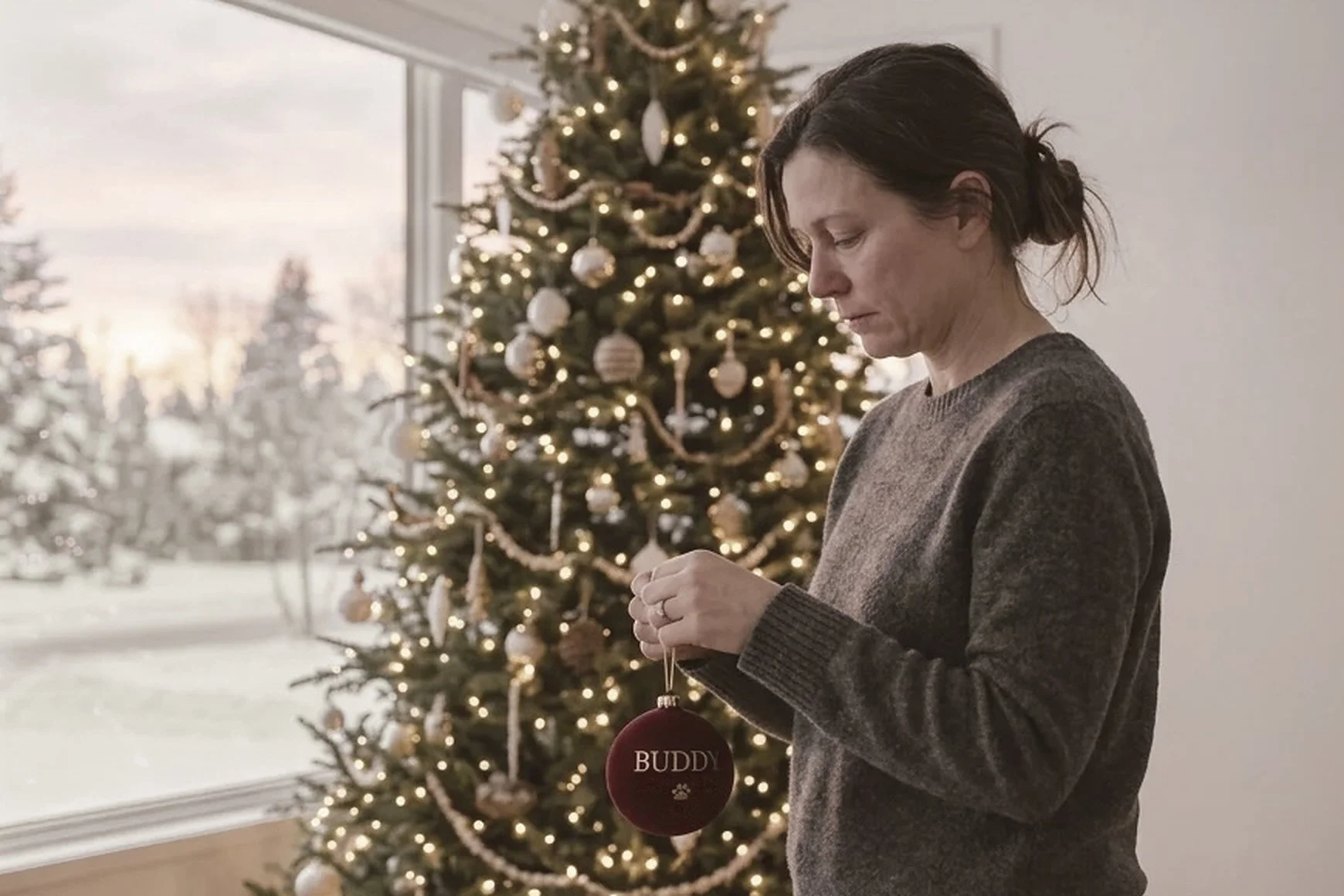
The box comes out of the cupboard the way it does every year. Someone has offered to help with the tree, and you said yes.
They work down through the layers. The lights, still in the knot they went away in. The glass ones in their tissue. Then a stocking with a name stitched across the top. They lift it out and hold it up.
“Shall I put this up?”
Last year nobody asked. It went on its hook beside the others because that was where it went. This year an ordinary question needs an answer, and you haven’t worked one out.
If it goes up, their name will be in the room every time you walk through it. You want that. You can also picture Christmas morning, when every other stocking has something in it.
If it stays in the box, there will be a space on the mantelpiece that only you can see. And you will know who decided to leave it there.
The person holding it is waiting. They are trying to help.
The direct answer
Hanging it is a reasonable choice. So is leaving it wrapped. Whichever you choose tonight, you can change it tomorrow, next week or on Christmas Eve. A stocking can go up on the 20th. It can come down again an hour after it went up.
So the first thing you need is time, and you can ask for it in one sentence:
“Could you leave that one with me? I’d like to decide later.”
That is a complete answer. The tree carries on, and the stocking stays in your hands, where nobody else will decide for you.
The reason this is hard has little to do with being ready. Their name on that stocking is proof that they belonged in this house at Christmas, and you want to see it. The flat shape of it is proof of what has changed, and you would give a great deal to avoid that. Both come from the same object. In a large survey of people whose pet had died in the previous year, keepsakes and other ways of staying connected comforted some people and distressed others, and the two could arrive together.1 You can want their stocking in its usual place and still dread seeing it empty on Christmas morning.
Key takeaways
- You can buy time with one sentence: “Could you leave that one with me? I’d like to decide later.” Hanging the stocking and leaving it wrapped are both reasonable, and either can be changed.
- The research here did not test what to do with a pet’s Christmas decorations. A large survey of bereaved owners does show that one keepsake can comfort and hurt at once, so you can decide without waiting for a clear feeling.
- A more useful question than “Am I ready?” is “Which part hurts?” Their name, the empty place, and taking it down unfilled each point to a different choice.
- When two people at home want different things, split the decision: whether it hangs, where, and who answers when a guest asks.
- Plan two moments most Christmas advice skips: the first hour of Christmas morning, and the day the decorations come down.
Why the decorations box can hurt weeks before Christmas
Their everyday things have been in front of you since the day they died. The bed, the lead on its hook. Some you have moved. Some, like the bowl you cannot put away, are exactly where they left them. Either way, you have walked past them hundreds of times, and you have had practice at seeing them.
The decorations box is different. It was packed away last January, when they were alive. They may have been in the room while you did it, nosing at the tissue or sitting in the empty box. Whoever folded that stocking assumed, without thinking about it, that there would be another Christmas to hang it for.
Nobody has touched it since. So when the lid comes off, you meet a part of the loss you have had no practice with at all. It can feel like being thrown back to the first week, which is frightening if you thought you had steadied. What has happened is narrower than that. You have come across one piece of their life for the first time, and it has reached you months late.
The box holds more than the stocking. A bauble with their name on it. The felt robin with a chewed wing. Last year’s gift tag in your own handwriting. If you had a cat, perhaps the bottom third of the tree, which you stopped decorating years ago and could decorate now.
All of this happens in late November or early December. It is easy to brace for Christmas Day and be caught instead by an ordinary evening and a cardboard box. In its guidance for bereaved owners, the University of Florida’s veterinary hospital points out that a special day brings back what the two of you did on it, now out of reach, and says the build-up tends to be harder than the day when it comes.2 That is practitioner guidance, and your Christmas may go differently. It does tell you that the weeks before are a recognised part of this, and that grief hitting you again when you thought you were coping can have a cause you can point to.
What research can and cannot tell you
No study found for this article tested what people should do with a pet’s Christmas decorations. Anyone who tells you that hanging the stocking helps, or that putting it away helps, is giving an opinion. That includes the suggestions further down this page, which are practical options and are described as such.
The nearest useful evidence is about keepsakes in general. In 2017 Janice Habarth and colleagues reported a survey of 4,336 people whose pet had died within the past year.1 They asked about the ways people stay connected to a pet who has died, which researchers call continuing bonds. Going back over fond memories is one. Holding on to belongings is another.
Two findings matter to someone holding a stocking. The owners surveyed drew on many kinds of connection, and the same kind soothed one person and upset another. And a single connection could soothe and hurt in the same moment.1
What this gives you is modest and practical. If you are waiting until the stocking only comforts you before you hang it, you may be waiting for a feeling the evidence does not promise. If you are reading the pain as a sign that it belongs in the box, the same evidence says pain and comfort can come from one object. Mixed is the expected condition. You can decide on other grounds, which is what the next section is for.
The authors are careful about what a single survey can show. Because everyone answered once, it cannot say whether leaning on the comforting connections is good for people in the long run, and they call for studies that follow owners over time.1
In practice
Their stocking, bauble or ornament
“Am I ready?” is hard to answer because it asks you to predict a feeling, and because it implies there is a direction you ought to be heading in. A more useful question is this: which part hurts?
There are three likely candidates, and they lead to different choices.
Seeing their name. The name may be the whole point for you. It is the one place in the house where they are still listed with the family, and the bauble or the stocking wants to be somewhere you will see it on purpose. Or the name may be what catches you, every time, on the way to the kitchen. Then you can have it up and still choose where: on the side of the tree that faces your chair, on a branch you have to turn to see, or in the room where you sit in the evenings.
Seeing the empty place. Here the pain is the gap in the row, the hook with nothing on it. Hanging the stocking closes the gap. So does rearranging the others so that the row is new this year. You could also put something else on the hook, a collar tag or a small light, so the place stays theirs.
Taking it down unfilled. This one is about a moment that has not happened yet. You can already see yourself in January, lifting down a stocking that hung empty for a month. Or you can see it on Christmas morning, flat beside the full ones. If this is the part that hurts, put something in it. A handwritten memory, one line from each person in the house. A card recording a donation made in their name. NC State’s veterinary school includes a donation in the pet’s name among its suggestions.3 On the day the decorations come down, it comes down with something inside.
That leaves a short list of choices, each as considered as the others:
- The bauble on the tree and the stocking left in its tissue.
- The stocking hung where it always goes, with a handwritten memory inside.
- The stocking hung somewhere private, on your bedroom door or beside their photograph.
- Nothing this year. The lid goes back on.
The last of these takes as much thought as any of the others.
The stocking has spent eleven months of every year in that box. It was theirs the whole time.
Leaving it there this December keeps every choice open for next year.
Practitioners suggest similar things, and it helps to know these are suggestions drawn from practice, and neither source presents them as tested findings. A letter to your pet, a candle lit in remembrance and a tree ornament carrying their picture all appear on the University of Florida’s list.2 Jeannine Moga, a veterinary social worker whose guidance NC State published in 2016, gives the example of one more star on the tree, a ritual kept and altered for the one who has died.3
Buy time. “Could you leave that one with me? I’d like to decide later.”
Name the part that hurts. Their name, the empty place, or taking it down unfilled.
Choose for this year only. Next December gets its own decision.
Give it one evening. Put it where you think you want it. If you want it moved by bedtime, move it.
Tell one person. Then nobody tidies it away or hangs it for you.
Leaving the lights on
You may be leaving a light on for them this December. The tree, a lamp in the window, a candle at dinner.
It might be there so they can find the way home. It might say that a dog or a cat lived in this house and is still counted. It might be something your hands began doing in the first week, and you have never asked why.
Whichever it is, it belongs to you. You can leave a light on with a firm belief about what it does, with none at all, or with a different answer each night. It needs nobody else’s agreement, and you owe nobody an explanation at the dinner table.
One practical note. If the light you want is one that lasts all night, make it a battery candle in the window, and let the tree lights go off at bedtime.
When two people at home want different things
Take one example and follow it through.
One of you wants the stocking up. Since the first few weeks, nobody has said the dog’s name. Friends have stopped asking. If the stocking stays in the box, December will pass without that name appearing anywhere, and it will feel as though the whole house has agreed to move on.
The other dreads it. Guests are coming for Christmas dinner. Somebody will notice the stocking and ask, or will notice and say nothing, which is worse. Somebody may ask whether you are getting another one. They cannot face explaining it over the roast potatoes and feeling their voice go.
Each is protecting something. The first needs the name to be seen. The second needs to be spared the questions. Both needs can be met, because “shall we hang it?” is really four questions: whether it goes up, where, who speaks when someone asks, and what they say.
So the arrangement might be this. The stocking goes up in its usual place. The person who wanted it there takes every question about it. The two of you agree the answer beforehand, short enough to say without stopping: “That one is our dog’s. It’s our first Christmas without them and we wanted their name up.” And the one who wanted it up might ask for a single thing in return: that the dog’s name gets said once during the day, in passing, in a sentence about something else.
If your partner is the one who dreads the questions, you could say, “I’d like to hang it. If anyone asks about it at dinner, I’ll answer.”
If you’re the one who finds it hard to answer, you could say, “I’d like to hang it. Would you answer if anyone asks?”
And if you are the one who dreads it:
“Hang it if you want to. I can’t be the one who explains it.”
If none of those works, there are halfway places. The stocking can hang in a room guests do not use. It can be up every evening until Christmas Eve and rest in its tissue while the house is full. Either arrangement can be looked at again next year.
The University of Florida’s guidance encourages bereaved owners to tell supportive people what they need on a special day, and to let them know that mentioning the pet is welcome. Silence from friends, it observes, usually comes from a fear of upsetting you, and hearing the name spoken tends to comfort.2 The person across the room from you may have been avoiding the name out of care. They cannot know which you want until you say.
In practice
When the rest of the family wants Christmas as usual
Wider family is harder to brief, because the conversation is shorter and often happens by message. Relatives who want you to have a good day often settle on cheerfulness as the way to give you one.
Four sentences cover most of it.
About the name. “You can talk about them. I’d like it if you did.” Or the opposite, which is just as fair: “I’d rather not talk about them at the table this year. Ask me another day.”
About being cheered up. “You don’t need to cheer me up. I’m fine being a bit quiet.” The Florida guidance covers this too. Cheering-up can hurt, it says, and nobody has to be handed the job of removing your pain.2
About leaving the room. “I may step outside for ten minutes at some point. I’ll come back.” Moga’s advice starts from your energy: take stock of it truthfully, accept fewer invitations, and arrange your exit before you arrive.3
About doing less. “Could you do the vegetables this year?” Florida’s guidance puts the cooking, shopping and planning among the jobs another person can take this year.2
If you send only one message before the day, send the one about the name. It is the question your family is least likely to ask you and most likely to be wondering about.
Decide what you want said. Their name welcome, or their name left alone for the day.
Send it ahead. One message to one person who will pass it on.
Agree a signal. A word or a look that means you are stepping out and do not need following.
Hand over one job. The one you used to do with them underfoot.
In practice
Christmas morning, when their job has gone
Every pet had a job at Christmas. The cat who was first into the wrapping paper. The rabbit who got the carrot tops. The dog under the table from the moment the oven went on.
Stay with one of them: a dog who woke the household. For years, Christmas morning began when they decided it did. A nose at the bedroom door at six. The lead, and a lap of the block in the dark while everyone else slept. Then back to a house that was awake because they had made it so. Nobody opened anything until the dog had been out.
This year you may wake at six anyway. Your body has kept the appointment, and you may find you are still listening for them. The house is quiet. The first guest arrives at noon. Between waking and company there are six hours, and that interval is where their job used to be.
It is worth deciding the night before what goes there.
Keep part of the walk. The same route at the same hour, shortened to the corner and back. You could carry the lead in your coat pocket. You could go the other way round the block if the usual way is too much.
Ask for company at their time. “Could you come at nine instead of twelve?” Or, to someone who would understand: “Will you walk with me at eight on Christmas morning? Twenty minutes.” A phone call at that hour does the same work.
Give the hour a job. Whatever needs doing first, the oven, the table, the bird feeder, can go in the slot they used to fill, so that the day has a first thing in it.
Wake up somewhere else. A Christmas Eve spent at someone else’s house changes the morning entirely. That is a fair use of an invitation.
These are practical options. None comes from a study of pet owners at Christmas. They are in keeping with what veterinary social work guidance suggests for the season, which is to choose your commitments, adapt the ritual and ask for support.3
Then there is the person for whom the morning goes well. Breakfast is good. Somebody says something funny and you laugh properly, and for twenty minutes you are a person at a table at Christmas. Then it lands. You had stopped thinking about them.
Florida’s guidance speaks to exactly this. It treats a day that turns out lighter than you feared as part of grieving, with nothing disloyal in it.2 Moga calls these stretches “grief breaks” and says they can help.3 Twenty good minutes at breakfast and the thought that follows them belong to the same morning. There is more on this in Why Smiling Again After Pet Loss Feels So Wrong.
Decide the first half hour the night before. A walk, a call, the oven or a slow start. Any plan is better than an open morning.
Let breakfast be good. If the guilt comes afterwards, it can sit beside the good part.
Have a way out of the afternoon. Ten minutes outside, agreed in advance.
Taking the decorations down
A lot of advice about Christmas and grief stops on the 25th. The box still has to be packed.
Putting their bauble away can feel like a second goodbye. For a month their name has been out in the room, with a reason to be there. Now you are wrapping it in tissue and closing a lid, and the house goes back to having no particular place for it.
You are also packing for someone. A year from now a person will open this box, and it will be you. Whoever packed it last January did so without knowing. You know.
So this decision can be made reversible as well.
Keep one ornament out. Their bauble on a window latch or a bookshelf, all year, where a decoration turns into a keepsake.
Photograph where it hung. Before anything comes down, take one picture of the stocking on its hook or the bauble on its branch. Next December you can put it back in the same place, or choose a new one knowing where the old one was.
Wrap it and write their name on the box. Give their things a small box of their own inside the big one, with a label. Next year you will see the label before you see the stocking, and opening it becomes something you choose to do.
If there are notes in the stocking, they can stay there. Next year it will come out of the box already holding them.
You can share the job. “Could you do the rest of the tree? I’ll do theirs.” Or the reverse, if you would rather someone else closed the lid.
Pick the day as well. Some households take everything down by the sixth of January. Theirs can come down last, or stay up a week longer than the rest.
New Year and the dates that follow
New Year has its own difficulty. At midnight the last year they were alive in comes to an end, while the people around you call it a fresh start.
Then January arrives. The visitors have gone, the routines are back, and the ordinary days have their absence in them again.
One study is worth knowing about here, with clear limits. Deborah Carr and colleagues used a long-running study of older married couples in the Detroit area, and looked at 210 people interviewed six months after their husband or wife had died. January interviews carried more depressive symptoms and more anxiety about the loss than interviews at other times of year. December interviews looked no different, though only ten took place that month. Loneliness once the holiday activity stops is one explanation the authors offer. By eighteen months the pattern had gone.4
These were older adults grieving a husband or wife, in one American city, compared by the month in which their interview fell. No equivalent study of pet owners was found for this article. So it is a pointer and no more. The stretch after Christmas may ask as much of you as the day did, and it is worth planning one thing for the second week of January while you are planning the 25th.
Other dates come after that. Their birthday. The day they came home. The first anniversary. My Dog Died and I Want Him Back has a section on dates, seasons and the days that were theirs.
When Christmas needs more support
Christmas concentrates things. If you find yourself thinking that you want to be with them, or that you cannot keep yourself safe, treat that as urgent and speak to someone now.
If you need urgent support
- United States: 988 Suicide & Crisis Lifeline
- UK and Ireland: Samaritans, 116 123, at any time of the day or night
- Australia: Lifeline, 13 11 14
- Elsewhere: Find A Helpline
Support for the grief itself
- Blue Cross Pet Loss Support (UK): free and confidential, on 0800 096 6606 from 8.30am to 8.30pm every day of the year, with webchat and email as well.5
- Cornell University College of Veterinary Medicine pet loss support hotline (US): veterinary students trained by grief counsellors answer the calls. Check the current hours before relying on it over the holidays, because they change through the year.6
If, in the weeks after Christmas, you are struggling to eat, sleep or get through ordinary tasks, or things are getting heavier to carry, speak to your doctor or a counsellor. You can ask at any point. There is no date you have to reach first.
Frequently asked questions
Should I hang my pet’s stocking the first Christmas after they die?
Either choice is reasonable, and you can change it at any point in December. If you are stuck, ask which part hurts: seeing their name, seeing the empty place, or taking it down unfilled. Each one points somewhere different.
My pet died just before Christmas. Should we cancel it?
You can scale it. Keep one thing, drop one thing, and hand one thing to someone else. The University of Florida’s guidance allows for a day with nothing special in it, and for time on your own.2 A smaller Christmas is a third option between a full one and none.
Is it strange to buy them a present or a new bauble this year?
No. An ornament carrying your pet’s picture appears among the University of Florida’s suggestions for the day.2 What you do with it in January is covered in the section on taking the decorations down.
What do I say if a guest asks about the stocking?
Agree one line in advance and decide who says it. For example: “That one is our dog’s. It’s our first Christmas without them and we wanted their name up.” A short answer closes the subject kindly and leaves room for the guest to say something back.
I enjoyed Christmas Day and now I feel guilty. What does that mean?
It means the day had good parts in it, and that you noticed their absence afterwards. Veterinary guidance treats a lighter day as part of grieving,2 and time away from grief as something that can help.3
What should I do with their decorations when Christmas is over?
Three options, all of which can be undone. Keep one ornament out for the year. Photograph where it hung before you take it down. Or wrap it in its own labelled box, so that next December you choose when to open it.
“Shall I put this up?”
They are still holding it out. The question is still in the room.
You could say yes, and tell them where. You could say, “On the tree, but let me do it.” You could ask them to fold it back into its tissue, and write the name on the lid yourself. You could say, “Yes. Will you answer if anyone asks?”
Or you can hold out your hand and take it from them. The felt is flatter than you remember. The name is where it has always been.
“Leave it with me for tonight.”
That is an answer. The lights can go on either way.
Resources from The Pet Loss Studio
- FreeThe Healing Letter
A free weekly email for people grieving a pet. - FreeThe First 72 Hours After Pet Loss
A short guide sent by email, for anyone whose pet has died in the last few days. - PaidThe First Year Without You
A month-by-month book, in paperback and hardcover through Amazon.
Sources and further reading
- Habarth, J., Bussolari, C., Gomez, R., Carmack, B. J., Ronen, R., Field, N. P., & Packman, W. (2017). Continuing bonds and psychosocial functioning in a recently bereaved pet loss sample. Anthrozoös, 30(4), 651 to 670. Read studyBack to text
- University of Florida Small Animal Hospital. Coping Through Holidays and Special Events. Visit resourceBack to text
- Bartel, J. (2016). Grieving for a Pet During the Holidays. NC State Veterinary Medicine. Guidance from Jeannine Moga, veterinary social worker. Visit resourceBack to text
- Carr, D., Sonnega, J., Nesse, R. M., & House, J. S. (2014). Do special occasions trigger psychological distress among older bereaved spouses? An empirical assessment of clinical wisdom. The Journals of Gerontology: Series B, 69(1), 113 to 122. Read studyFree full textBack to text
- Blue Cross. Pet Loss Support. Visit resourceBack to text
- Cornell University College of Veterinary Medicine. Pet Loss Support Hotline. Visit resourceBack to text